
Publish in Peer Community Journal
What is Peer Community Journal?
A 3-minute video about Peer Community Journal:

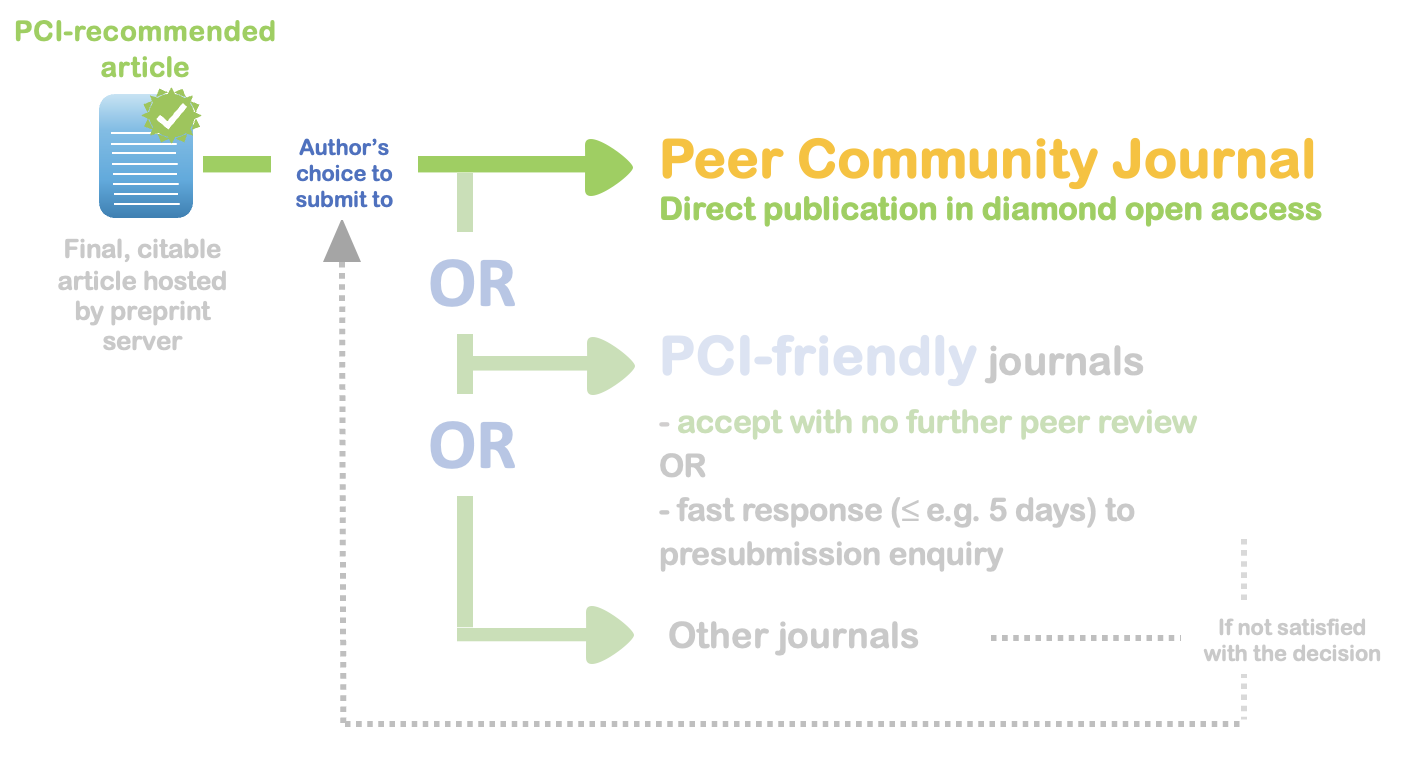
Once an article has been recommended by a PCI, the authors can opt to leave it on a preprint server, publish it in Peer Community Journal, submit it to a PCI-friendly journal, or submit it to any other journal.
Peer Community Journal is run by researchers for researchers and is funded by public research institutions. It is:
- Unique = it is a single journal for all PCIs
- Free = it is a diamond open-access journal (free for both authors and readers).
- Exclusive = it publishes only articles recommended by PCI
- Unconditional = it can publish any PCI-recommended article in its recommended version
- Opt-in = it publishes articles only if the authors wish it
- Immediate = after recommendation by a PCI, no delay between transfer to the journal and publication
- Community-based
Peer Community Journal is already indexed by several databases, among which Google Scholar, Web of Science, Scopus, Dimensions and Open Alex.
The articles published by Peer Community Journal are published under CC-BY license.
Governance of Peer Community Journal
The editorial board consists of the members of the managing boards of each thematic PCIs.
The journal has an executive board. Its members manage the logistics, funding, administrative aspects and promotion of the journal. The members of the executive board are the members of the board of the PCI organisation that publishes the journal.
This journal is created and funded by the PCI organisation.
The official publisher of Peer Community Journal is the PCI organisation.
For more information, read the statutes of the PCI organisation.
Originality of Peer Community Journal
This journal is original in that:
- It is free (diamond open access) for authors and readers,
- It is multidisciplinary, and will accept for publication any articles recommended by any of the PCIs (PCI Ecology, PCI Paleontology, PCI Mathematical & Computational Biology, etc., https://peercommunityin.org/current-pcis/),
- It is based on a transparent editorial process (PCI publishes reviews and all editorial processes of accepted articles),
- It provides an example of dissociation of the three stages of publication (the Publish-Review-Curate model): publication of a preprint in a preprint server or open repository, peer review via PCI, and publication by a journal.
- It unites the entire PCI community around a single journal.
FAQs
Why a journal?
Because authors may think the service PCI provides is not complete:
– Lack of visibility: Preprints recommended by PCI do not appear as recommended in the results provided by search engines.
– Lack of indexation: Preprints recommended by PCI are not indexed in the best-known databases (WoS, PubMed, Scopus, DOAJ) because preprints are not articles published in journals.
→ We will continue our efforts to have PCI-recommended preprints recognised as articles of high quality that do not need to be published in journals.
While awaiting this recognition (which will necessarily take time), Peer Community Journal will provide a means of publishing any PCI-recommended preprint without further modification and at no cost to the authors.
Isn't it a paradox to recommend preprints and then create a journal?
PCI’s goal is to promote preprints and recommended preprints and to ensure their recognition with a value equivalent to that of the best articles published in journals. However, most authors currently need to publish in journals (for evaluation, visibility, and indexation) and this requirement is likely to continue for the foreseeable future. Whilst it remains the rule to publish articles in journals, PCI will run Peer Community Journal to offer authors this option.
We hope that, in the long term, Peer Community Journal (and PCI-friendly journals) will create a large flow of submissions to PCI, leading to a situation in which it will be sufficient for authors to have PCI-recommended articles. Until then, PCI will continue to promote recommended articles.
Is there a danger of this journal playing the IF game?
No. The non-use of citation metrics is a condition laid down in the statutes of the PCI organisation, which is the publisher and owner of Peer Community Journal.
Isn't it a paradox to have strong links with PCI-friendly journals and then create a journal?
No, there is room for everyone. PCI-friendly journals are long-term established journals, with specific editorial policies and with specific communities of researchers seeking to publish in them. A scientist accustomed to publishing in a learned society journal, for example, may well continue to submit to this journal as a first choice. Peer Community Journal has been created to ensure that the authors of PCI-recommended preprints can publish their articles in a journal, without the possibility of refusal or time delay.
Can I still submit my PCI-recommended article to the journal of my choice?
Yes, the authors of PCI-recommended articles can do whatever they want with their articles: leave them on preprint servers, submit them to Peer Community Journal, a PCI-friendly journal, or any other journal.
Will Peer Community Journal last for long?
Yes. Funding from public research institutions is available to ensure the journal’s continued operation for at least the next 10 to 15 years.