Peer Community In

“Peer Community in” (PCI) is a non-profit scientific organization that aims to create specific communities of researchers reviewing and recommending, for free, unpublished preprints in their field.

Contact

contact@peercommunityin.org
Follow us on Twitter
LEGAL NOTICE

Image Credits

The network image was drawn by Martin Grandjean: A force-based network visualization - http://www.martingrandjean.ch/wp-content/uploads/2013/10/Graphe3.png. CC BY-SA.

Peer Community in

PCI, a free recommendation process of scientific
preprints based on peer reviews and a journal

SUPPORTED BY

FACTS & FIGURES

more than 2000 RECOMMENDERS
21 PCIs
more than 100 PCI FRIENDLY JOURNALS
1,886 SUBMISSIONS (31/12/2024)
4,623 PEER-REVIEWS (31/12/2024)
831 RECOMMENDATIONS (31/12/2024)
393 ARTICLES PUBLISHED IN PCJ (31/12/2024)
More than 200 SUPPORTING ORGANISATIONS

FEEDBACK

Share your suggestions and comments to improve this website! Contact us at contact [ a.t ] peercommunityin [ d.o.t ] org

PCI is a non-profit organization of researchers offering peer review, recommendation and publication of scientific articles in open access for free.

Following submission by authors, the thematic PCIs evaluate preprints in their scientific fields based on rigorous peer review. After evaluation, the PCIs may recommend those preprints, to make them complete, reliable and citable articles, without the need for publication in ‘traditional’ journals. Authors who need to publish their article in a journal can publish it for free in Peer Community Journal or submit it to a PCI-friendly or other journal.
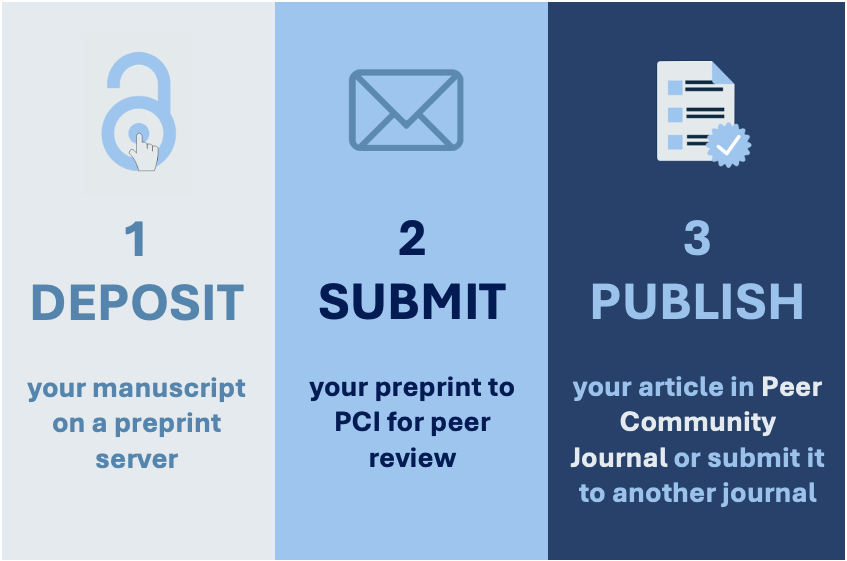


The recommendation of an article is a positive editorial decision made by a recommender based on at least two rigorous peer reviews and after one or several rounds of peer reviews.  The recommendations are published in the corresponding thematic PCI websites with a DOI and can be cited.

As part of the Diamond Open Access ecosystem, PCI allows scientists to regain control of the scientific publication process and disconnect it from financial issues. PCI also wants to refocus scientific quality on articles rather than on journals.

PCI IN A FEW WORDS

Stimulating: Each PCI recommends remarkable articles in its field.


Open: PCI is an open-science initiative based on:

  • open access to the recommended articles (on preprint servers and open archives)
  • open access to the evaluation (reviews, author’s responses and editorial decisions)
  • data, scripts and code available to the readers
  • an open infrastructure: The code, page texts (help texts, about, instructions, etc.) and automatic Email templates are available on the PCI github repository https://github.com/pci-dev.


Free: The whole PCI process is free for any user (readers, authors…). The websites of the PCIs are freely accessible.


Independent: PCI in not-for-profit and non-commercial. It is managed by scientists for scientists. Conflicts of interest are carefully checked at each step of the process.


Inclusive: An article recommended by a PCI may subsequently be published in a traditional journal (although this is not the goal of the PCIs).


Reliable: Decisions are based on sound evaluations by at least 2 reviewers. The Managing Board checks the quality of reviews, decisions, and recommendations.

Peer Community In complies with publishing ethics guidelines.

REASONS TO BELIEVE IN PCI

The PCI evaluation process is high-quality, free, and transparent. It is likely to succeed for the following reasons:


1. It fulfills the open science commitments requested by an increasing number of institutions, countries, funding agencies

  • All articles recommended by PCI have open data, scripts, and code.
  • All articles recommended by PCI are open access, freely accessible on preprint servers or institutional open archives
  • PCI ensures transparent peer review

2. It results in a peer-reviewed article that can be cited as is or published in a journal

  • Authors are free to either leave their recommended article on the preprint server or, if they need journal articles for their career, to publish it directly to Peer Community Journal or submit it to a PCI-friendly journal

3. It provides a solution to value reviewing and editorial work

  • Recommendations (and associated reviews) are citable with their DOI
  • Reviewers can choose to publish their names or to remain anonymous
  • Institutions have direct access to the reviewing work of their researchers since each recommender of a thematic PCI has a page for displaying and reporting their reviews, comments, and recommendations (example).

4. It focuses on the scientific contents of articles and watches out for the ethical rules of publication

  • Conflicts of interest are kept track of throughout the process
  • Financial conflict of interest are forbidden
  • In specific fields of research, PCI mandates approval from ethics committees and institutional review boards

5. It shares the workload between researchers

  • Recommenders, unlike associate editors in traditional scientific journals, have no commitment to review and recommend papers. Each recommender is rather encouraged to review and recommend 1 or 2 articles per year in average.
  • Because of the high number of recommenders, PCI will not be jeopardized if some recommenders are inactive and if the number of submissions sharply increases.

6. It benefits from a solid infrastructure

  • PCI is managed by scientists from research institutions.
  • It was funded by the French National Open Science Fund.
  • It is financially supported by many universities and research bodies.
  • PCI ensures long-time conservation of its contents in CLOCKSS.

HOW DOES PCI WORK?

Peer Community In: What is it?

“[...] thorough & speedy handling! Thank you also to @MatthewPetelle & an anonymous review for their excellent feedback [...]”

Corina Logan, Max Planck Institute Evol Anthropology

"a very constructive review process with @PCIEvolBiol”

Helen Alexander

“The @PeerCommunityIn is one of the most innovative & exciting current initiatives in scholarly communication & #openscience”

Ben Marwick, University of Washington

"very nice interface. I love the concept too, of course ;)”

Leonardo Martins, Quadram Institute

“The associated recommendation is absolutely lovely and a nice way to finish a let's say very special work year”

Maxime Dahirel, PostDoc Inrae

“Pushed waves are just the best ! Thanks a lot to @benflips and @PCIEvolBiol for this beautiful recommendation”

Elodie Vercken, Inrae

“I really recommend to every scientists that value #OpenScience to submit their next papers to @PCIEvolBiol, it was a great and pleasant experience.”

Jonathan Romiguier, Cnrs

“All this to say: submit your preprint to @PCIEvolBiol you won't be disappointed”

Nicolas Bierne, Cnrs

“I am much more excited than ever when a paper was accepted in a standard journal. This system is just awesome!”

Nicolas Bierne, Cnrs

“The extraordinary work done by @PeerCommunityIn is slowly but surely being recognized. #PeerCommunityIn is paving the way to a more accessible and democratic research. I'm a proud recommended of @PCI_Ecology and honnered to take part to this fantastic journey.”

Cédric Hubas, MNHN

“a very helpful & supportive recommendation @PCI_Ecology”

Dieter Lukas, Max Planck Institute Evol Anthropology

“I would love to see something along the lines of @PCIEvolBiol for our field. Seems like that could save a lot of people a lot of time.”

Alex Perkins, University of Notre Dame

“a very good experience, and very high quality editorial work”

Matteo Tomasini, PostDoc, University of Gothenburg

“Really great experience to submit our work to @PCIEvolBiol”

Nicolas Negre, University of Montpellier

“@PCIEvolBiol should be the future if funding agencies and universities stop looking at impact factors to evaluate your CV @DORAssessment”

Luis Castañeda, University of Chile

“I highly recommend it.”

David Rasmussen, North Carolina State University

“thorough and transparent review process.”

JB André, Cnrs

“Much faster, and more humane.”

Ben Philips, University of Melbourne

“a highly rewarding experience, as usual”

Nicolas Galtier, Cnrs

“Free, high quality reviews of pre-prints.”

Ana Rivero, Cnrs

“@PCIEvolBiol it! That will move it forward.”

Thomas Couvreur, IRD

“It was a very easy and uncomplicated process!”

Claudia Kasper, Agroscope

“a good experience, I am happy to have contributed to this #OpenScience alternative.”

Miguel Navascués, Inrae

“Delighted to support @PCIEvolBiol and experience their professionalism & dedication [...]This is how scientific publishing should be: by the community and for the community!”

Rainey Lab, Max Planck Institute for Evol Biol

“I've had a great experience with @PCI_Ecology, the open peer review is excellent [...]”

Ben Farrar, PhD Student, University of Cambridge

“an excellent, transparent, thorough #OpenScience #PeerReview experience! ”

Chris Jolly, PostDoc Charles Sturt University

“a refreshing and all around great experience.”

Andrew Helmstetter, PostDoc CESAB

“We highly recommend fellow researchers to give PCI a try !”

Thomas Lesaffre, PhD Student, University of Lille

“@PCIEvolBiol initiatives should be the future anyway”

David Duneau, PostDoc, Université Toulouse III

“A high-quality, impartial, and transparent reviewing process. All free (as in free beer) and #openaccess. What else do we need?”

Samuel Alizon, Cnrs

“inspiring to see how peer review can work well in a preprint-first publishing world!”

Grey Monroe, University of California, Davis

“Once again, this was a wonderful experience and I strongly recommend everyone to submit their work to @PCIEvolBiol!!!”

Joël Meunier, Cnrs

How can you know whether or not a preprint has been recommended by a PCI?

Submit your preregistration to Peer Community In for peer review!

PCI economic model – General principles